The Science of Learning is Only Part of the Story

Recently, I had the pleasure of learning from Dr Efrat Hurst, a cognitive scientist, at Churchie’s A Matter of Translation Conference on 13 July 2026 and again that Wednesday evening.
My interest in the cognitive science of learning is grounded in both professional experience and personal curiosity. Through my doctoral work with Dr Anita Collins, a neuromusical educator and researcher, and my completion of the Bigger Better Brains Facilitator course, I developed an understanding of the neuroscience of learning in music.
That interest deepened when I became a mother. In 2017, I was given the draft of The Lullaby Effect (Collins, 2018) to read and provide feedback on. The ideas in that work became even more meaningful as I began thinking about learning, development, and the brain through the lens of parenting. With epilepsy also present in my family, I have a personal interest in understanding how the brain works.
So, there are several reasons why the cognitive science of learning matters deeply to me.
Dr Hurst provided an analogy of learning as a process of:
Knowing
Understanding
Using
Mastery
As a music educator, this is what we do daily. We believe that students need to know the basics such as musical terms, elements and concepts, techniques, and compositional devices. They need to understand how and why those ideas and techniques work in music they perform and compose. When they know and understand them, they can begin to use that knowledge in practical ways through performing, composing, analysing, and/or experimenting and improvising. And to be honest, from my experience, I believe students learn to know and understand when they sing, use instruments and composition technology. As such, I think of learning more like a Venn diagram where knowing, understanding and using overlap. I mentioned this to Dr Hurst, and she agreed that there are many ways we learn, though the process is best explained using these four phrases.
Students demonstrate mastery when they can apply their knowledge confidently and independently, make informed musical decisions, adapt their skills to new, unfamiliar or unexpected situations, and explain or justify their choices. In other words, they move from simply remembering information to unconsciously thinking and working like real musicians.
This information is not learnt overnight. Like Dr Hurst explained, learning isn’t always easy, we often “move on” so to speak, and need to retrieve that information later. Where I work, this is evidenced in semester-based electives. When Year 7 and 8 students study music for one semester each year, Year 8 students need to retrieve the information taught the year prior when they return to the class. This is tricky given not all students learn an instrument, sing in a choir, or are a member of a music ensemble in between times.
Memory, Retrieval and Motivation: A love-hate relationship?
We are taught retrieval practices as teachers and how the science of learning sets our students up for success. What is rarely discussed is what Dr Hurst called a ‘non-cognitive’ factor – motivation.
What motivates an adolescent student, and in my case, an adolescent male student - to retrieve, remember, or even care about something they learnt last year? I also propose that if their memories of classroom music are not favourable, or if the learning was not valued, what they know and understand is impacted. I also argue that this may influence whether students want to use those skills again and determines their standard of behaviour.
It is interesting that the research Dr Hurst referred to found exams and testing as the motivation for improved memory and retrieval. Whilst I don’t disagree, I certainly feel my findings and the findings of others can contribute to this discussion.
In their books Reaching Boys, Teaching Boys (2010), and I Can Learn From You (2014), Reichert and Hawley explore the relational aspects that support boy’s educational success. They speak about student-teacher relationships as an important factor for boys’ motivation to learn and engage. ‘Openness to continuous reassessment of their relational approaches’ (Reichert & Howley, 2014, p. 31) when an approach wasn’t working, was found to improve boy’s learning and overall achievement. Though their work doesn’t specifically address how the sex of the teacher may influence relational learning, my research concurs.
In this blog post, I’ll refer to the Adolescent Male Music Student (AMMS) findings from my thesis. Overarching Theme 2 was: ‘A female teacher does have to work harder’: The interplay of respect, sexism and behaviour on music learning’.
Below I have reproduced Figure 7.2 (Pearse, 2025, p. 236) that illustrates the theme and sub-themes that emerged.
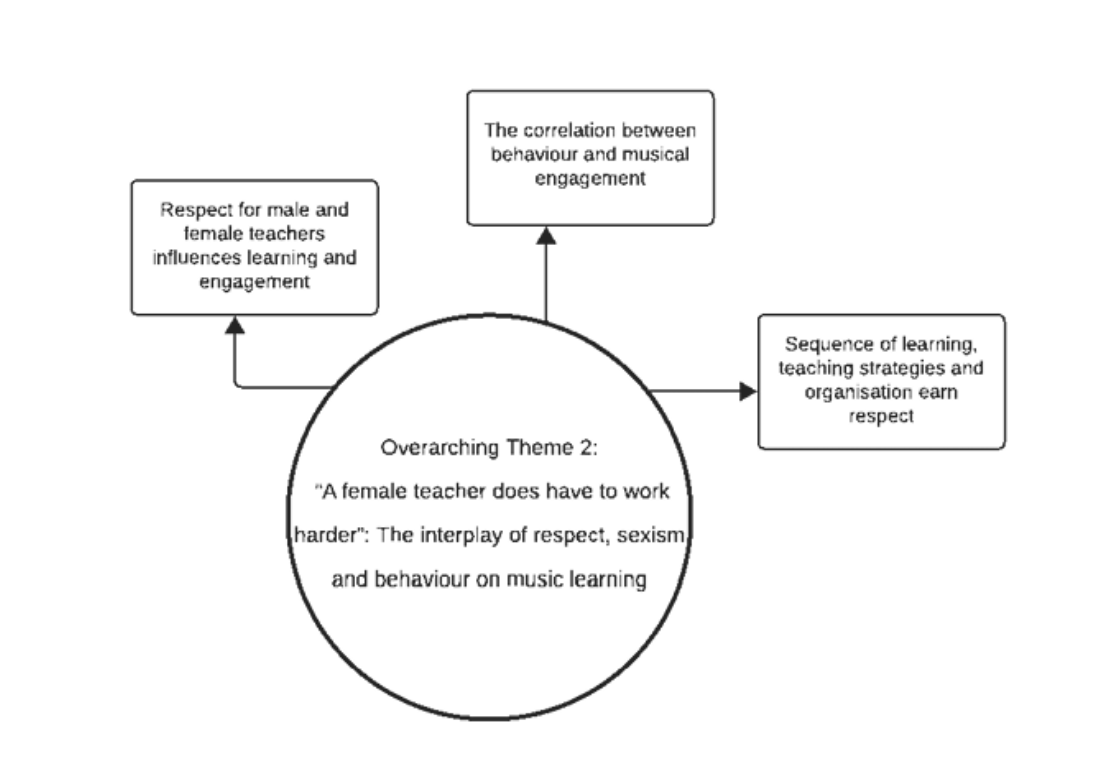
Figure 7.2 (Pearse, 2025, p. 236)
The analysis of the findings found that:
100% of the AMMSs indicate that for boys to learn music, FMTs [Female Music Teachers] FMTs, unlike MMTs [Male Music Teachers], must first address disrespect, sexism and stereotypical attitudes. Evidence across 100% of the focus groups suggests that a lack of respect for FMTs and MMTs impacts students’ perceptions of what an effective music teacher is, and this results in disengagement from music learning (Pearse, 2025, p. 236).
I also found that a lack of motivation for music learning and engagement is influenced by a culture of sport that celebrates a hegemonic masculinity where, unfortunately, music struggles to compete.
So, I pose this question:
How do we improve the relationship between the cognitive science of learning and the non-cognitive aspects of learning such as motivation?
As a teacher, a parent, and a researcher, I have my own thoughts and opinions. I agree with Ryan and Deci (2000) who stated that:
Motivation is hardly a unitary phenomenon. People have not only different amounts, but also different kinds of motivation. That is, they vary not only in level of motivation (i.e., how much motivation), but also in the orientation of that motivation (i.e., what type of motivation) (p. 54).
I was motivated as a child because I wanted top grades in everything I did. I didn’t like getting into trouble and found threats to sell my piano because of my messy room, were very motivational. In my world it was a combination of external and internal motivation. Gosh, even completing my doctorate was motivated by both external and internal factors. I certainly had my eye on the fancy gown and floppy hat, but I was equally driven by a desire to understand how the sex of the teacher shaped teaching practices and boys' engagement in learning.
While there may not be one definitive answer, I do think we cannot discuss the science of learning without considering what motivates students to engage and take responsibility for their learning.
And as teachers, how do we tap into different forms of motivation? Hegemonic masculinities and gender stereotypes continue to shape the world our students inhabit. They also shape how students perceive and respond to us, meaning that the sex of the teacher can influence motivation and learning in ways we do not always recognise or understand.
I’ll end by suggesting that the science of learning is only part of the story. If we want students to engage, persist, and take ownership of their learning, we also need to understand what motivates them, and how factors such as gender stereotypes, hegemonic masculinities, and even the sex of the teacher can shape that motivation.
References
Pearse, M. (2025). In tune with boys: How the sex of the teacher and gender stereotypes impact how music is taught and learned in all-boys schools (Doctoral thesis, University of Canberra). https://doi.org/10.26191/jraf-nm76
Reichert, M., & Hawley, R. (2014). I can learn from you: Boys as relational learners. Cambridge, MA: Harvard Education Press.
Reichert, M., & Hawley, R. (2010). Reaching boys, teaching boys: Strategies that work--and why. John Wiley & Sons.
Ryan, R. M., & Deci, E. L. (2000). Intrinsic and extrinsic motivations: Classic definitions and new directions. Contemporary educational psychology, 25(1), 54-67.